
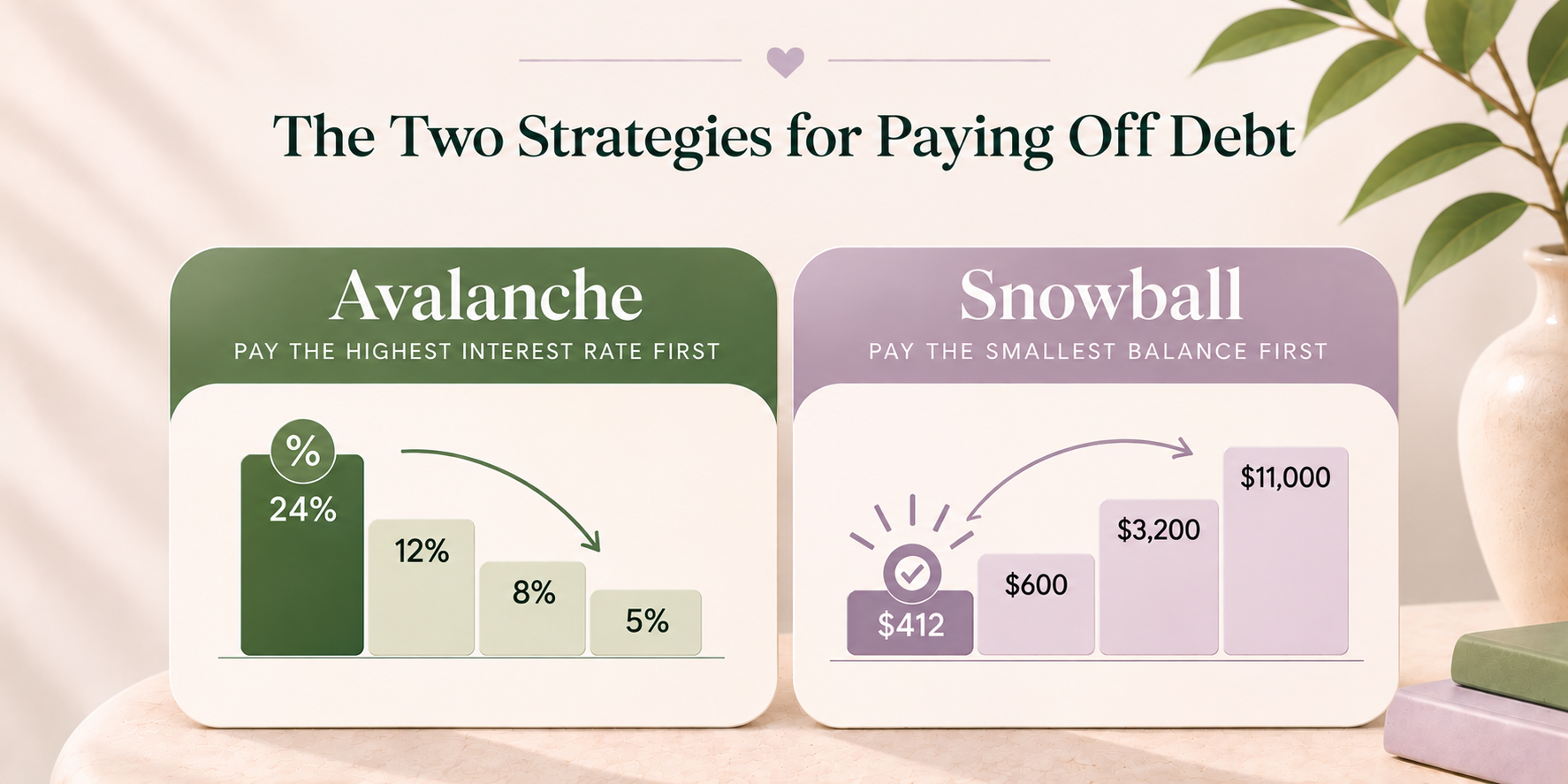
The Two Strategies for Paying Off Debt

The two strategies for paying off debt: avalanche and snowball

Monthly PROSPR Newsletter

The Two Strategies for Paying Off Debt

📲 Talk with our coach

Most people throw money at their debt and hope it moves faster.

Then they look up six months later, frustrated that the debt balance barely shifted compared to everything they put in. The problem usually isn’t the amount. It is that there was no strategy.

Rivka* came in with five debts. A car loan, two credit cards, a medical bill, and a store card she had almost forgotten about. She was making the minimum payment on all five every month. After those minimums and her regular expenses, she had about $750 left over, and the question was where to send it.

She sent all of it to the credit card charging 24% interest, because that was the debt costing her the most. Four months later, she had put nearly $3,000 extra toward that card. The debt balance had gone from $11,000 down to just under $9,000.

“I’ve spent a lot of money and it feels endless.”

She was almost done trying.

So Rivka changed her strategy. She kept paying the minimums on everything, but redirected the extra $750 to the smallest debt balance instead. The store card had $412 on it. She paid off that debt in three weeks.

Once the store card was paid off, nothing about her monthly payment changed. She was still paying the same $750, and now one fewer debt to split it across. So the full $750 went to the medical bill, on top of the minimum she was already paying there. That debt was $600, and it was gone the following month.

Two debts paid off in under two months. And on paper, she had lost money. Every one of those dollars could have gone to the 24% card, where it would have saved her more in interest. The store card and the medical bill were charging her far less, so paying them off first meant the expensive debt kept growing a little longer.

But success breeds success. Eighteen months later the 24% card was paid off too, which was never going to happen under her first strategy.

(Name changed)

The debate

Two methods, one long argument

Once the minimum payments are covered on every debt, most people have some money left to put toward paying off debts faster. Whatever that amount is, it should go to one debt at a time. There are two strategies for deciding which one, and the argument between them has been running for about thirty years.

The avalanche

Highest interest rate first.

Regardless of how large the debt balance is. Mathematically, this is correct. It costs less in total interest, sometimes substantially less, and no serious analysis disputes that.

The snowball

Smallest debt balance first.

Regardless of interest rate. It costs more in interest, and it does not always help to be debt free any sooner. What it does is help you reach your end goal, wiping out your debt.

Logic demands that the avalanche is the winner, but research shows otherwise.

What the research says

What actually happens

Researchers looked at about six thousand people working to pay off their debt. They wanted to know what separated the people who got it done from the people who gave up.

What predicted success was not the dollar amount someone had paid. It was the number of debts they had completely paid off.

Two people could put the same amount of money toward their debt in a year. The one who had paid off three small debts was far more likely to still be going. The one who put the same money into one large debt balance was far more likely to stop.

Starting with the smallest balance

14% more likely at year one. 43% more likely at year four.

That is how much more likely those people were to be completely debt free, compared with everyone else working at it.¹

This is why the snowball works. It is not a better strategy on paper, and it never claims to be. What it does is let someone taste success early, while the hardest part of the process is still ahead of them.

Success breeds success.

Paying off a debt completely is a real win, and that win creates the motivation to go after the next one. The snowball is built to produce the first success as fast as possible.

Inside the PROSPR Plan

The Debt Relief Calculator

Here is the part worth being plain about: paying off the smallest debt balance first often means paying more in total interest. But total interest is not the only number that matters. The question that matters more is how long until you are debt free.

The Debt Relief Calculator takes every debt balance and every interest rate and runs both strategies side by side. For each one it shows:

Side-by-side results

  • How many months until each individual debt is paid off
  • The exact month each one is gone
  • Total interest paid on each debt
  • Total interest paid overall
  • The date you become debt free

With both versions on the screen, the answer stops being a matter of opinion. The numbers show which strategy gets you debt free soonest, and that is the one to run.

Once a strategy is selected, the Plan produces a month-by-month payment schedule. Every debt, every month, exactly how much to pay each debt.

That schedule also shows the part that makes either strategy work. When the first debt is paid off, the money that was going to it does not go back into the month. It snowballs into the next debt, stacked on top of the minimum already being paid there. So the second debt is paid off faster than the first, and the third faster than the second. The payments get bigger while the number of debts gets smaller, and the last stretch moves quickly.

🧩 Mini Action

List every debt currently owed, smallest debt balance to largest. Just the amounts for now.

💡 Then check whether anything is left over each month once the minimum payments on all of them are covered. Whatever that amount is, it is the money that goes toward your strategy, and it is what decides how fast any of this moves.

Then choose your strategy, avalanche or snowball. Based on that strategy, send the whole amount to one debt and keep paying the minimums on the rest. When that first debt is paid off, move the whole amount onto the next one.

And if there is nothing left over at the end of the month, that is worth knowing too. Next month’s newsletter covers exactly what to do from there.

Ask PROSPR

Money questions have a way of going unasked.

So here is a place to ask without that part.

Ask your question

Sources

¹ Gal, D. & McShane, B. (2012). Can Small Victories Help Win the War? Evidence from Consumer Debt Management. Journal of Marketing Research.

² Kettle, K., Trudel, R., Blanchard, S. & Häubl, G. (2016). Repayment Concentration and Consumer Motivation to Get Out of Debt. Journal of Consumer Research.

³ Amar, M., Ariely, D., Ayal, S., Cryder, C. & Rick, S. (2011). Winning the Battle but Losing the War: The Psychology of Debt Management. Journal of Marketing Research

When Credit Card Rewards Become Work

Credit card rewards and household spending

Monthly PROSPR Newsletter

When Credit Card Rewards Become Work

📲 Talk with our coach

The card came through. So why did it feel like work?

Chaya* was proud of her system, and she had earned the right to be. Flights for the whole family last summer. A hotel stay that cost nothing but taxes. Cash back that covered most of a month of groceries.

She knew which card earned the most at the supermarket, which one to use for gas, which statement closed on the eleventh and which one closed on the twenty-sixth.

It worked. Every balance was paid. Nothing had ever gone to interest.

Then one afternoon she said something almost in passing:

“I spend more time thinking about this than I want to be.”

That was the sentence worth pausing on.

Not a single dollar had been lost. But somewhere along the way, the system had quietly become a second job, and nobody was paying her for the hours.

(Name changed)

What the research says

Here is the part most people never see

Yes, the rewards are real. What almost nobody notices is what the rewards do to the spending underneath them.

A 1% cash-back offer

Spending increased 32%. Debt increased 8%.

When one large bank introduced a simple 1% cash-back offer, spending on those cards increased 32% and debt increased 8%. Credit bureau data confirmed it was new spending, not spending moved over from somewhere else.*

Federal Reserve study

$76 increase per month.

A separate Federal Reserve study found the same pull in a different way: reward cards drew a $76 increase per month out of the average household compared with cards without rewards.**

The offer works exactly as designed. You get into more debt, and they increase their revenue.

What happens at PROSPR

Clients arrive with cards that were each added for a good reason. A rebate on the mortgage. Cash back at the grocery store. A signup bonus that was genuinely worth taking. Each decision made sense on its own.

What shows up in the Plan is not the number of cards. It is the spending.

When a threshold has to be hit to unlock a benefit, things start getting bought to reach it. Actual spending sits right next to planned spending, category by category, and the categories that run over are almost always the ones where a card was earning the most.

PROSPR Pro-Tip

The fix is never to cut up the cards.

Keep the 3 to 5 cards that pay the most on life as it is already being lived. A family that drives constantly should hold the card that earns on gas. The card should match life, rather than stretching life to match the card.

Rewards can make things a little easier here and there, and that is a perfectly good reason to use them. The cost is simply worth knowing before deciding it is worth paying.

🧩 Mini Action

List every credit card open right now, and next to each one, what is the card’s benefit.

💡 Any card that takes a second to answer has already said something.

Cut those and notice what it frees up. The difference usually shows up in headspace rather than in dollars.

When credit card companies feel like they’re helping you, they may already be costing you.

Does this feel familiar? Looking for clarity?

PROSPR is here to help.

Click for clarity

* Agarwal, S., Ang, S.H., Wang, Y., & Zhang, J. (2026). Cash-back rewards: Effects on spending and debt accumulation. Journal of Banking & Finance, vol. 184.

** Agarwal, S., Presbitero, A., Silva, A.F., & Wix, C. Who Pays For Your Rewards? Redistribution in the Credit Card Market. Finance and Economics Discussion Series 2023-007, Board of Governors of the Federal Reserve System.

I Make Six Figures, But I Still Worry About Money

I Make Six Figures, But I Still Worry About Money

Stressing over money doesn’t stop when you become a high earner. That can be a curse — and a blessing.


The investing information provided on this page is for educational purposes only. NerdWallet, Inc. does not offer advisory or brokerage services, nor does it recommend or advise investors to buy or sell particular stocks, securities or other investments.

By most every metric, I am a wealthy person.

I own three cars and a home. I have an emergency fund, a retirement fund and a college savings fund for my son. I have no debt outside of my mortgage. I have a six-figure salary, in addition to my husband’s income.

My net worth puts me in the category of “high earner, not rich yet.”

I don’t say this to brag; it’s more of a shameful confession. Despite having the trappings of wealth, I don’t feel wealthy.

A lack of money has been a persistent feature of my life until fairly recently.

My parents weren’t rich, and as a highly sensitive child, I deeply felt that reality. I noticed the bank overdraft notices on the kitchen counter, overheard the fights about money, and sensed the vibe of desperation. Worrying about money became my default setting.

It’s not worry over the current state of the economy. Most Americans making $125,000 or more have concerns about the economy, according to the Conference Board’s June Consumer Confidence Index report.

I constantly worry about money and whether I have enough. It is one of the last things I think about at night and one of the first things I think about in the morning.

Lately, I’ve been calculating the big expenses that are in my family’s future — car maintenance, family vacations — and wondering how much longer my husband’s 13-year-old car will last.

I run other questions through my head, too: How much money do I have until my next payday? Are we saving enough for retirement?

Scarcity mindset is real

I suspect that most of us, regardless of income, worry about money.

We sifted through Reddit forums to get a pulse check on how high earners feel about scarcity mindset. We used an AI tool to help analyze the feedback. Here’s what rose to the top of our analysis. People post anonymously, so we cannot confirm their individual experiences or circumstances.

Based on the comments, many high earners, particularly those who grew up with limited means, struggle with a scarcity mindset.

This manifests as excessive worry about spending money, guilt over purchases (even small ones), and constant fear of losing wealth despite having high salaries. Some mentioned earning $300,000-$500,000 and having substantial savings.

Sounds familiar.

The solution for me, then, must be psychological. I’ll have to shift my mindset about money.

Money scripts create money worries

My early experiences shaped my belief that money scarcity is a source of anxiety and conflict, and that conversely, having a lot of it would create peace.

Simi Mandelbaum, a certified financial therapist and founder of PROSPR Financial Wellness, called this my “money script” — a largely subconscious belief about money that drives financial behaviors.

But money scripts are only partly true, according to Brad and Ted Klontz, who coined the term.

Mandelbaum says that a lot of high earners worry about money in part because of flawed money scripts.

“People think, ‘When I earn X amount of money, my life will be happy,’” she says. “When money doesn’t make them content, it stresses them out.”

Flipping our money scripts

I’ve certainly realized the lie in my own money script. Lots of money doesn’t bring peace. Yes, it buys me a stable lifestyle that comes with having a home, reliable transportation and good health care. But peace is another matter.

My money script — authored by financial instability — made me hypervigilant about money.

“It’s helpful to get to know your anxiety and what form it takes in order to then bridge the gap between what has happened and what you would like to happen,” Mandelbaum says.

Over on Reddit, many suggested that finding the right balance between saving for the future and living in the present is key to overcoming a scarcity mindset.

Users recommended therapy, setting up specific budgets that include guilt-free spending, building a larger emergency fund, and the importance of perspective — money is a means to an end, not the goal itself.

As for me, I’d like to rewrite my money script to this: I already have enough.


A little worrying can pay off

I have another confession. I’ve grown to like worrying about money.

Yes, I should worry less, but it’s also true that the careful attention I bring to my finances, borne out of money worries, has literally paid off.

Painful memories of not having enough money have motivated me to become a responsible steward of the money I have today.

Because I worried about retirement, I started investing in a 401(k) at 21. I increase those contributions whenever I get a raise, which serves as an effective moderator against lifestyle creep.

When I perform my daily financial audit every morning, I look for evidence of fraud. When we found unauthorized charges on my husband’s debit card a few years ago, we acted quickly and avoided any financial liability.

One of my friends recently asked about my financial ritual, wondering if things could be that different from one day to the next.

“I won’t know unless I check,” I responded.

Here’s the thing: No one cares about my money like I do, so it’s my responsibility to manage, monitor and nurture it. Worrying about money helps me make the best financial decisions for my family.

And if I’ve done my job correctly, my son won’t ever know the feeling of not having enough. That will make me feel like the richest person in the world.