

The Two Strategies for Paying Off Debt
Most people throw money at their debt and hope it moves faster.
Then they look up six months later, frustrated that the debt balance barely shifted compared to everything they put in. The problem usually isn’t the amount. It is that there was no strategy.
Rivka* came in with five debts. A car loan, two credit cards, a medical bill, and a store card she had almost forgotten about. She was making the minimum payment on all five every month. After those minimums and her regular expenses, she had about $750 left over, and the question was where to send it.
She sent all of it to the credit card charging 24% interest, because that was the debt costing her the most. Four months later, she had put nearly $3,000 extra toward that card. The debt balance had gone from $11,000 down to just under $9,000.
“I’ve spent a lot of money and it feels endless.”
She was almost done trying.
So Rivka changed her strategy. She kept paying the minimums on everything, but redirected the extra $750 to the smallest debt balance instead. The store card had $412 on it. She paid off that debt in three weeks.
Once the store card was paid off, nothing about her monthly payment changed. She was still paying the same $750, and now one fewer debt to split it across. So the full $750 went to the medical bill, on top of the minimum she was already paying there. That debt was $600, and it was gone the following month.
Two debts paid off in under two months. And on paper, she had lost money. Every one of those dollars could have gone to the 24% card, where it would have saved her more in interest. The store card and the medical bill were charging her far less, so paying them off first meant the expensive debt kept growing a little longer.
But success breeds success. Eighteen months later the 24% card was paid off too, which was never going to happen under her first strategy.
(Name changed)
The debate
Two methods, one long argument
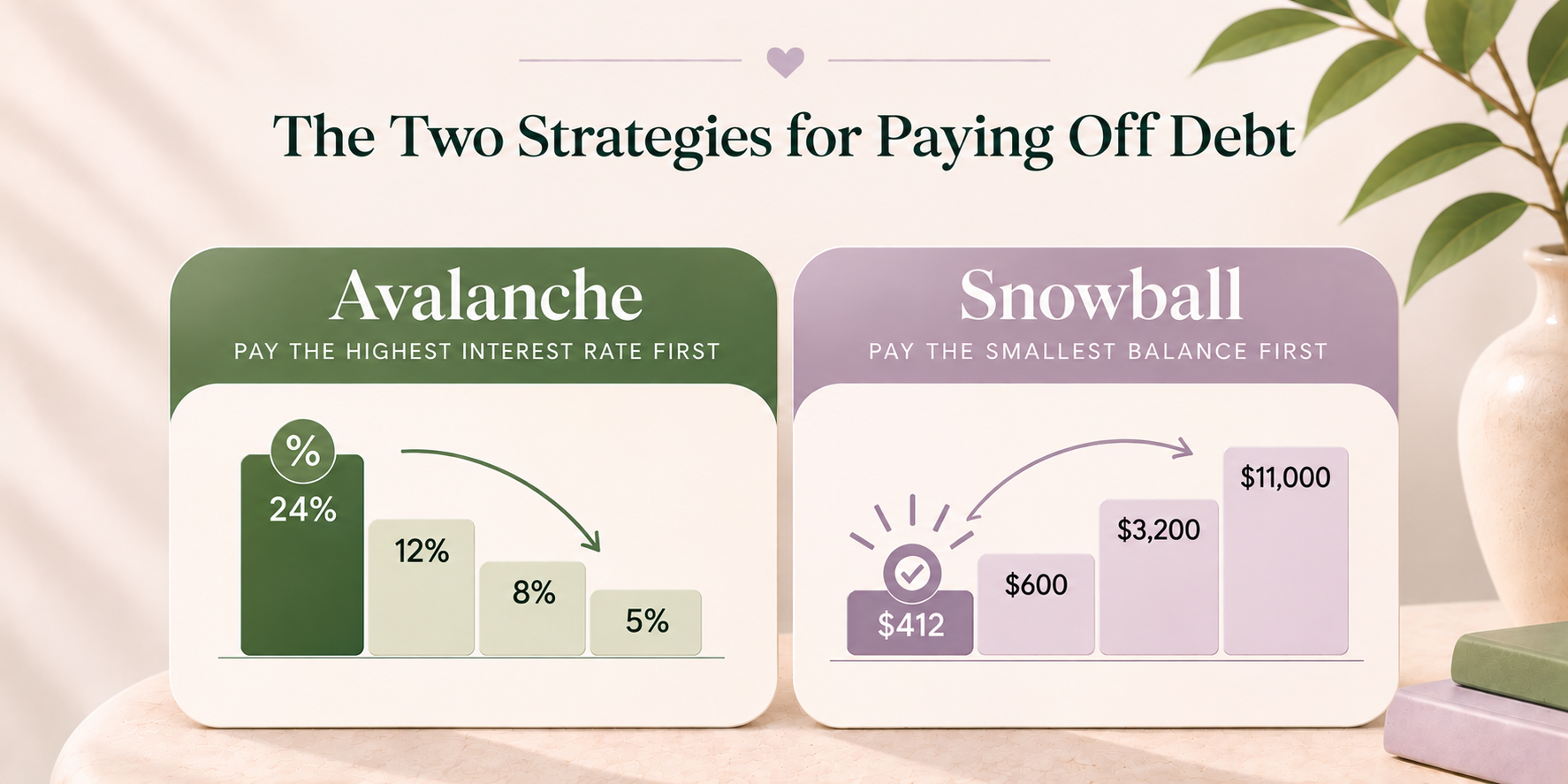
Once the minimum payments are covered on every debt, most people have some money left to put toward paying off debts faster. Whatever that amount is, it should go to one debt at a time. There are two strategies for deciding which one, and the argument between them has been running for about thirty years.
Highest interest rate first.
Regardless of how large the debt balance is. Mathematically, this is correct. It costs less in total interest, sometimes substantially less, and no serious analysis disputes that.
Smallest debt balance first.
Regardless of interest rate. It costs more in interest, and it does not always help to be debt free any sooner. What it does is help you reach your end goal, wiping out your debt.
Logic demands that the avalanche is the winner, but research shows otherwise.
What the research says
What actually happens
Researchers looked at about six thousand people working to pay off their debt. They wanted to know what separated the people who got it done from the people who gave up.
What predicted success was not the dollar amount someone had paid. It was the number of debts they had completely paid off.
Two people could put the same amount of money toward their debt in a year. The one who had paid off three small debts was far more likely to still be going. The one who put the same money into one large debt balance was far more likely to stop.
14% more likely at year one. 43% more likely at year four.
That is how much more likely those people were to be completely debt free, compared with everyone else working at it.¹
This is why the snowball works. It is not a better strategy on paper, and it never claims to be. What it does is let someone taste success early, while the hardest part of the process is still ahead of them.
Success breeds success.
Paying off a debt completely is a real win, and that win creates the motivation to go after the next one. The snowball is built to produce the first success as fast as possible.
Inside the PROSPR Plan
The Debt Relief Calculator
Here is the part worth being plain about: paying off the smallest debt balance first often means paying more in total interest. But total interest is not the only number that matters. The question that matters more is how long until you are debt free.
The Debt Relief Calculator takes every debt balance and every interest rate and runs both strategies side by side. For each one it shows:
- How many months until each individual debt is paid off
- The exact month each one is gone
- Total interest paid on each debt
- Total interest paid overall
- The date you become debt free
With both versions on the screen, the answer stops being a matter of opinion. The numbers show which strategy gets you debt free soonest, and that is the one to run.
Once a strategy is selected, the Plan produces a month-by-month payment schedule. Every debt, every month, exactly how much to pay each debt.
That schedule also shows the part that makes either strategy work. When the first debt is paid off, the money that was going to it does not go back into the month. It snowballs into the next debt, stacked on top of the minimum already being paid there. So the second debt is paid off faster than the first, and the third faster than the second. The payments get bigger while the number of debts gets smaller, and the last stretch moves quickly.
List every debt currently owed, smallest debt balance to largest. Just the amounts for now.
💡 Then check whether anything is left over each month once the minimum payments on all of them are covered. Whatever that amount is, it is the money that goes toward your strategy, and it is what decides how fast any of this moves.
Then choose your strategy, avalanche or snowball. Based on that strategy, send the whole amount to one debt and keep paying the minimums on the rest. When that first debt is paid off, move the whole amount onto the next one.
And if there is nothing left over at the end of the month, that is worth knowing too. Next month’s newsletter covers exactly what to do from there.
Money questions have a way of going unasked.
So here is a place to ask without that part.
Sources
¹ Gal, D. & McShane, B. (2012). Can Small Victories Help Win the War? Evidence from Consumer Debt Management. Journal of Marketing Research.
² Kettle, K., Trudel, R., Blanchard, S. & Häubl, G. (2016). Repayment Concentration and Consumer Motivation to Get Out of Debt. Journal of Consumer Research.
³ Amar, M., Ariely, D., Ayal, S., Cryder, C. & Rick, S. (2011). Winning the Battle but Losing the War: The Psychology of Debt Management. Journal of Marketing Research